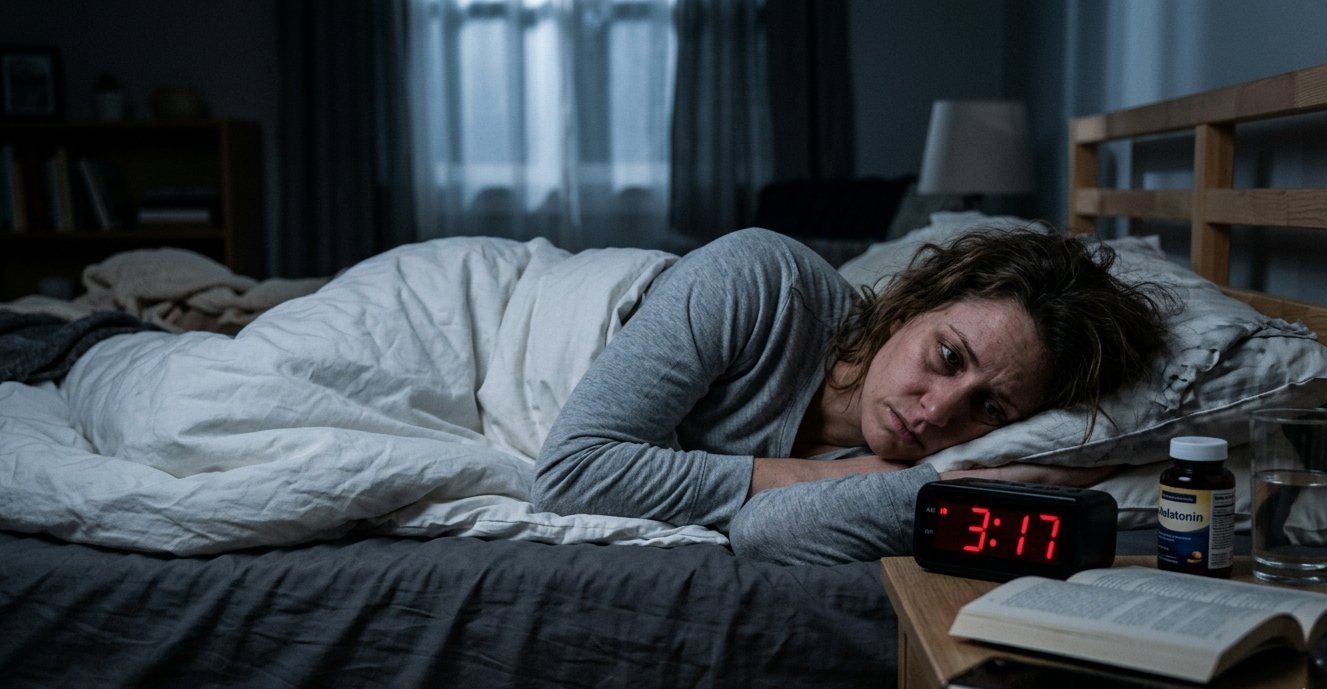
You fall asleep without much trouble. Then your eyes open in the dark and the clock reads 3:17. The house is silent, your mind is suddenly loud, and you already know the next ninety minutes will be spent negotiating with the ceiling. By the time sleep finally returns, the alarm is close enough to make it pointless.
If you're over 40, this pattern probably feels personal — like a failure of willpower, or stress, or one too many coffees. It usually isn't any of those things. What changes after 40 is measurable, it's well-documented in the sleep-science literature, and almost nobody bothers to explain it in plain language.
So that's what this article does. Not a miracle, not a cure — just the actual mechanism behind the 3 A.M. wake-up, why the most popular fix (melatonin) so often disappoints, and where the conversation is quietly moving next.
The system that controls sleep pressure
Your drive to sleep isn't mystical. While you're awake, a molecule called adenosine steadily accumulates in the brain. The more it builds, the heavier the "sleep pressure" you feel. It's the same system caffeine hijacks — caffeine works by blocking adenosine from docking, which is why a late coffee keeps you wired.
Two things shift this system as you age — and together they explain the 3 A.M. wake-up better than stress ever did.
Adenosine builds the pressure to sleep
Adenosine accumulates in the brain during waking hours and promotes the drive toward sleep — a core part of how the body regulates rest. When this signal is blunted, staying asleep through the night gets harder.
Porkka-Heiskanen et al. (1997), Science — adenosine accumulation during prolonged wakefulness. View source ↗The system weakens with age
The strength and timing of the body's homeostatic sleep regulation change as we get older, which is associated with lighter, more fragmented sleep and more frequent night-time awakenings.
Dijk et al. (2010), Sleep Medicine Reviews — age-related changes in sleep homeostasis. View source ↗Deep (slow-wave) sleep declines with age
The restorative deep-sleep stage measurably decreases with age. Less deep sleep means lighter sleep overall — and a lighter sleeper is far easier to wake in the small hours.
Mander, Winer & Walker (2017), Neuron — "Sleep and Human Aging." View source ↗Why melatonin so often disappoints
Melatonin signals when to sleep — it's a timing cue, not a sleep-maintenance switch. A large meta-analysis found its effect on chronic insomnia and sleep maintenance is limited, which is exactly why so many people say it "stopped working."
Buscemi et al. (2005), BMJ — meta-analysis of melatonin for sleep disorders. View source ↗Worth being clear: the studies above are general, independent sleep-science research. They describe how the sleep system works and ages — they are not studies of any specific product, including Yu Sleep. Nothing here is medical advice or a promise of results.
Does your sleep fit the 3 A.M. pattern?
Mark every symptom you've experienced in the last 30 days. This is a personal reflection tool, not a medical diagnosis.
What people are saying online
The quotes below are paraphrased from real posts in public sleep communities such as r/insomnia and r/sleep. They describe the problem people experience — they are not product reviews or testimonials for Yu Sleep.
"I wake up around 3 with anxiety attacks and these loops running in my head. I've dealt with insomnia since I was about 12. Now I'm 51 and some nights I just cry. I don't know what else to do anymore."
⚑ Paraphrased from real online community posts · r/insomnia"Started with 3 milligrams of melatonin. Then 5. Then 10. Now none of it does anything. I'm 47 and I'm genuinely worried about what the sleep deprivation is doing to my brain long-term."
⚑ Paraphrased from real online community posts · r/sleep"I've spent thousands — supplements, expensive pillows, a high-tech mattress, sleep apps, acupuncture, quitting coffee. I'm 68 and nothing has made a difference."
⚑ Paraphrased from real online community posts · r/insomniaMichael, 58, had made peace with bad sleep
For three years, Michael treated 3 A.M. as a fact of life. Wake up, check the clock, lie there. He blamed work, then age, then his mattress. He cycled through melatonin, magnesium, a white-noise machine, cutting caffeine after noon. Each helped for a week or two, then quietly stopped mattering.
What finally shifted his thinking wasn't another supplement — it was understanding why the waking happened in the first place. Once the mechanism made sense, the problem stopped feeling like a personal failing and started feeling like something with an actual lever to pull.
Michael is a composite — a representative story assembled from experiences commonly described by people over 40 dealing with mid-night waking. He is not a specific real customer, and this is not a testimonial of results.
What the research points toward
Here's the honest curiosity: the science above explains the problem — adenosine, aging sleep regulation, the limits of melatonin. The more interesting question is what you can actually do with that understanding.
The team behind Yu Sleep put together a short presentation walking through their approach to supporting the body's natural sleep-pressure system as it ages. We're not going to summarize the specifics here — partly because they explain it far better, and partly because the details matter and we'd rather you hear them accurately, from the source.
A note from the editor
Sleep is one of the most under-discussed pillars of long-term health. Chronic short and fragmented sleep is linked in the research literature to mood, metabolism, and cognition — yet most people are handed a melatonin gummy and sent on their way. We publish sponsored editorials like this one when a product's underlying premise lines up with credible, published science, and we label them plainly so you always know what you're reading. As always: this is education and opinion, not medical advice. For persistent sleep problems, see a qualified clinician.